
Angiogram & Angioplasty in Guntur
Best Angiogram Specialist in Guntur – Dr. Kamalakar | Kamalakar Heart Center
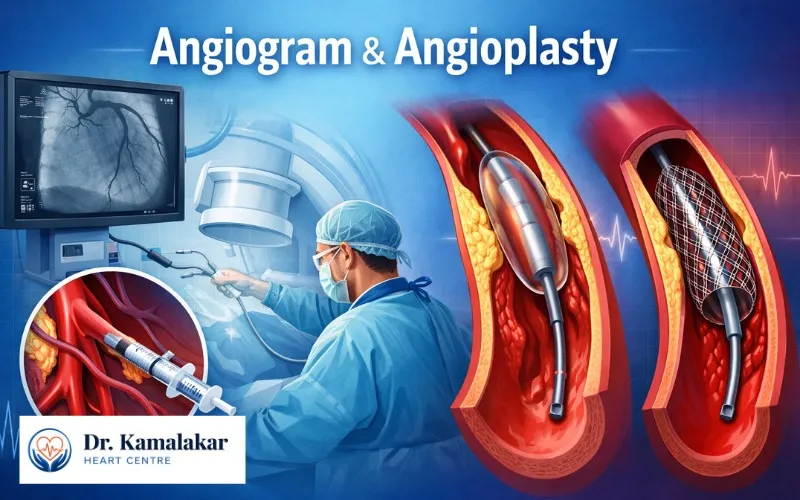
Angiogram and angioplasty are essential heart procedures used to diagnose and treat blocked arteries. These minimally invasive treatments play a critical role in preventing heart attacks and improving blood flow to the heart.
At Kamalakar Heart Center in Guntur, these advanced cardiac procedures are performed by Dr. Kamalakar Kosaraju, one of the best angiogram specialists in Guntur, using modern cath-lab technology and patient-focused care.
What is an Angiogram?
An angiogram (coronary angiography) is a diagnostic procedure used to identify blockages or narrowing in the coronary arteries.
During the procedure:
- A thin catheter is inserted through the wrist or groin
- Contrast dye is injected into the arteries
- X-ray imaging shows real-time blood flow and detects blockages
At Kamalakar Heart Center, Guntur, angiograms help in early and accurate diagnosis of heart disease.
What is Angioplasty?
If a blockage is detected, angioplasty (Percutaneous Coronary Intervention) is performed to restore normal blood flow.
- A balloon is inflated to open the blocked artery
- A stent is placed to keep the artery open
- The procedure is minimally invasive and performed under local anesthesia
This ensures effective treatment with faster recovery.
Best Angiogram & Angioplasty Services in Guntur
At Kamalakar Heart Center, we provide:
- Treatment by Dr. Kamalakar Kosaraju – leading angiogram specialist in Guntur
- Advanced cath-lab facilities at Life Hospital, Guntur
- High success rate in angioplasty procedures
- Personalized care for every patient
- Minimal discomfort and faster recovery
Who Needs Angiogram or Angioplasty?
You may require these procedures if you experience:
- Chest pain or discomfort (angina)
- Shortness of breath
- Abnormal ECG or stress test results
- Previous heart attack
- Risk factors such as diabetes, BP, or high cholesterol
Early diagnosis at our heart center can prevent major complications.
Benefits of Angiogram & Angioplasty
- Early detection of heart blockages
- Prevention of heart attacks
- Minimally invasive procedure
- Quick recovery time
- Improved heart health and quality of life
Conclusion
If you are looking for angiogram or angioplasty in Guntur, consult Dr. Kamalakar Kosaraju at Kamalakar Heart Center for advanced and reliable cardiac care.
How Angiogram & Angioplasty Works
Consultation
Dr. Kamalakar evaluates symptoms and medical history.
Preparation
Basic tests are conducted and fasting is advised before the procedure.
Angiogram
A catheter-based imaging procedure to detect blockages.
Angioplasty (If Required)
Balloon and stent are used to open blocked arteries.
Recovery
Short observation period followed by discharge with follow-up care.
Angiogram & Angioplasty – Frequently Asked Questions
An angiogram is a test that uses contrast dye and X-rays to detect blockages in heart arteries.
Dr. Kamalakar Kosaraju at Kamalakar Heart Center is one of the most trusted angiogram specialists in Guntur.
It usually takes about 30 to 45 minutes.
Yes, angioplasty can be performed in the same session if blockage is found.
Yes, medications are prescribed to support recovery and prevent complications.